
Feasibility Study on the future HPCI (Quantum Hybrid)
Research on HPC and Quantum Computing Resources for Next-Generation Computing Infrastructure
Hybrid computing infrastructures that combine supercomputers with emerging computational paradigms—such as quantum Ising machines—are gaining worldwide attention as a key technology supporting next-generation science and engineering.
This project is conducted as part of a national research initiative on next-generation computing infrastructure supported by the Ministry of Education, Culture, Sports, Science and Technology (MEXT), Japan. The goal of the project is to explore the feasibility of future computing environments that integrate the supercomputing infrastructure HPCI with quantum and Ising-type computing resources.
Japan has played a pioneering role in the development of Ising machines, beginning with the theoretical proposal of quantum annealing. The country has built a strong technological foundation spanning hardware, software, and application research. This project brings together these domestic technologies and investigates how they can be integrated into next-generation computing infrastructures and deployed in real-world applications.
Research Objectives
This research examines how emerging computational paradigms—including quantum computing and Ising machines—can be integrated with future flagship supercomputers and the HPCI system. The main objectives are:
- Investigating integration methods between supercomputers and emerging computing technologies such as Ising machines
- Studying operational models and user environments for hybrid computing infrastructures
- Developing a roadmap for next-generation quantum computing technologies, including gate-based quantum computers
Through these efforts, the project aims to clarify the role and feasibility of quantum computing in future large-scale computing infrastructures.
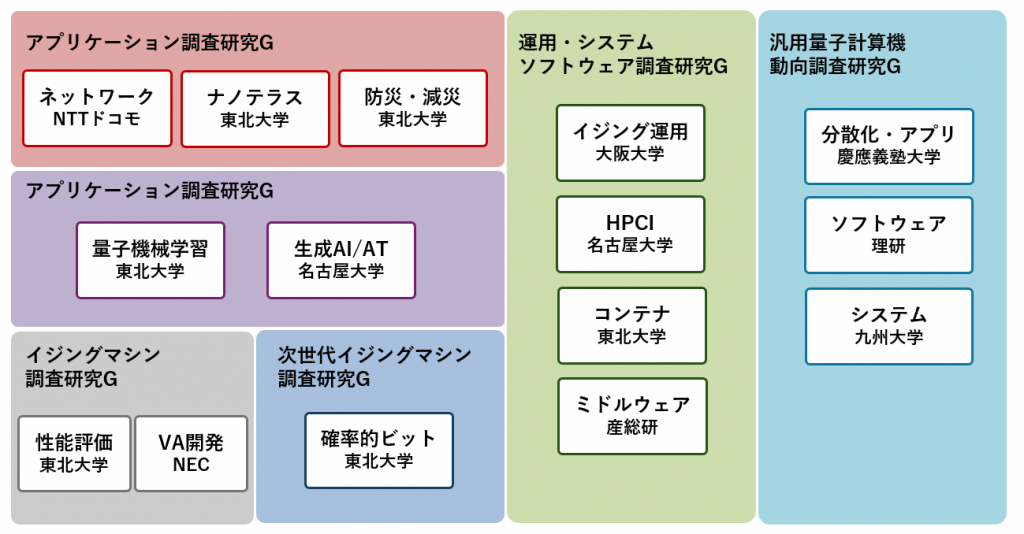
Research Organization
This project is led by Tohoku University and is conducted through a collaborative framework involving universities, research institutes, and industry partners.
The research activities are organized into six groups, each focusing on a specific area of expertise while closely coordinating with one another.
Ising Machine Research Group
This group investigates Ising-type computing technologies, including quantum annealing and simulated quantum annealing, and evaluates their potential integration with the HPCI supercomputing infrastructure.
Operations and System Software Research Group
This group studies operational frameworks and system software required to integrate quantum Ising machines with supercomputing environments.
Software for Emerging Computational Paradigms Group
This group examines software environments for utilizing Ising machines, including libraries, development tools, and automatic tuning technologies.
Application Research Group
This group explores potential use cases in areas such as disaster prevention, telecommunications, and scientific measurement.
Next-Generation Ising Machine Research Group
This group investigates future computing paradigms such as p-bit computing and coherent Ising machines.
Quantum Computing Technology Survey Group
This group surveys the technological trends in quantum computing, ranging from current NISQ devices to future fault-tolerant quantum computers (FTQC).
Future Outlook
Quantum Ising machines and universal quantum computers have the potential to achieve computational performance beyond that of conventional supercomputers for certain classes of problems.
By integrating these emerging computing technologies with existing high-performance computing infrastructures, this project aims to contribute to strengthening Japan’s scientific capabilities and industrial competitiveness.